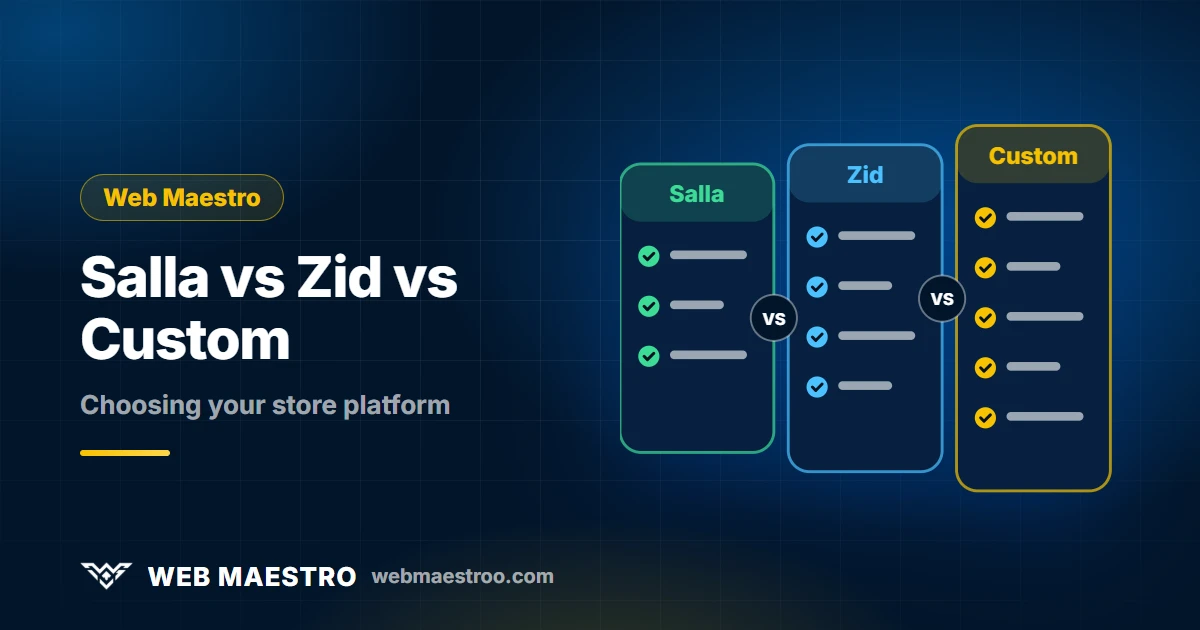
Salla and Zid are Saudi e-commerce platforms that let you open an Arabic-first online store quickly, with local payments and shipping already connected, for a monthly subscription. A custom store is built for your business and costs more to build, but gives you full control over design, workflows, integrations and data. For most new Saudi stores, Salla or Zid is the faster start; a custom store makes sense when your catalogue, operations or integrations outgrow what a platform allows.
Key takeaways
- Salla and Zid are both strong, Arabic-first choices for starting and growing a store in Saudi Arabia.
- The difference between them is usually smaller than the difference between either platform and a custom build.
- Compare the current plans, fees and apps on each platform's own website; they change often.
- Choose a custom store when you need unusual workflows, deep integrations or full control of the customer experience.
- Many businesses start on a platform and move to custom later. Plan your data so that move is possible.
What Salla and Zid have in common
- Arabic-first: Arabic dashboards, storefronts and support, built around the Saudi market.
- Local payments: options such as mada, Apple Pay, STC Pay and buy now, pay later services like Tabby and Tamara, depending on your plan and approvals.
- Shipping: connections to local shipping companies and order tracking.
- App stores: add-ons for marketing, reviews, loyalty, accounting and more.
- Themes: ready-made designs you can customise within the platform's limits.
- Hosted service: the platform handles servers, security updates and uptime.
How to compare Salla and Zid for your store
Instead of asking which platform is "better", test both against your own needs. Open a trial or demo on each and check:
- Plans and fees: the monthly plan you would actually need, transaction fees and the cost of the apps you will add.
- Payments: which methods you can enable for your business type, and how quickly payouts reach your account.
- Shipping: whether your preferred carriers and cities are supported, including cash on delivery if you need it.
- Themes: whether a theme matches your brand without heavy workarounds.
- Apps and integrations: your accounting system, ERP, warehouse or marketing tools.
- E-invoicing: how the platform supports ZATCA (Fatoora) requirements for your business.
- Reports and data export: whether you can export products, customers and orders easily.
- Support: response times and channels, in Arabic.
Write the answers in one table. The right choice is usually obvious once you compare them against your real list, not a generic feature list.
When a custom store makes more sense
- Complex products: configurable items, measurements, bundles, B2B price lists or quotes.
- Special workflows: approvals, subscriptions, rentals, bookings, multi-branch stock or marketplace sellers.
- Deep integrations: real-time sync with an ERP, warehouse system, CRM or your own mobile app.
- A distinctive experience: a brand that needs a design or checkout that platform themes cannot deliver.
- Scale and control: high order volume where platform fees and limits start to cost more than ownership.
- Selling beyond Saudi Arabia: several countries, currencies and languages in one store.
For a wider comparison with global platforms, see our article on Shopify vs WooCommerce vs a custom store.
Side-by-side overview
| Salla or Zid | Custom store | |
|---|---|---|
| Time to launch | Fast, often days to weeks | Longer: weeks to a few months, depending on scope |
| Upfront effort | Low | Higher: design and development |
| Ongoing costs | Monthly plan, apps and transaction fees | Hosting, maintenance and payment fees |
| Design freedom | Within theme limits | Full |
| Workflows | Standard, extended by apps | Built for your business |
| Integrations | Available apps and APIs | Any system with an API |
| Ownership | You rent the platform | You own the code and data |
A middle path: platform plus custom work
You do not always have to choose one extreme. Many stores stay on Salla or Zid and add custom work around them: a custom theme, a connection to their ERP through the platform's API, or a separate landing site for campaigns. This keeps the convenience of a platform while solving the one or two things it cannot do on its own.
Planning for a future move
- Use your own domain from day one, not only the platform's subdomain.
- Keep product data clean: names, descriptions, images and SKUs you can export.
- Export customers and orders regularly.
- Keep URLs simple so redirects are easy if you move.
These habits protect your search rankings and your customer list if you later move to another platform or a custom store.
Common mistakes
- Choosing by the lowest monthly plan without counting the apps you will need.
- Building a custom store for a simple catalogue that a platform would serve well.
- Staying on a platform long after workarounds cost more than a custom solution.
- Launching on the platform's subdomain and losing search history when moving later.
- Ignoring e-invoicing and returns until after launch.
Frequently asked questions
Is Salla better than Zid?
Neither is better for everyone. Both are established Saudi platforms. The right one depends on your products, the payment and shipping options you need, the apps you rely on and the plan that fits your size. Test both with your real requirements.
Can I move from Salla or Zid to a custom store later?
Yes. Products, customers and orders can usually be exported and imported into a new store. Plan redirects for your old URLs so you keep your search rankings.
Do you design stores on Salla and Zid?
We focus on custom stores and integrations, and we help businesses decide honestly whether a platform or a custom build fits them better. When a platform is the right answer, we say so.
How long does a custom store take?
With AI-assisted development, a focused custom store can launch in weeks rather than months. Large catalogues, many integrations or marketplace features add time. Our guide on how long it takes to build a website explains what affects the timeline.
Next step
Not sure which path fits? Describe your store in our project planner, see our e-commerce service in Riyadh and Jeddah, or contact us.
This article is no longer available. Back to blog