"How much does an app cost?" is one of the first questions every founder and manager asks, and the honest answer is that it depends on what the app has to do. Two apps with similar screens can be very different projects once you look at the system behind them. This guide explains the ten factors that decide the cost, so you can plan a budget and compare quotes with confidence.
Short answer: the cost follows features and the system behind the app more than the number of screens. A focused first version with the core features costs far less than a full platform, and most apps also need a back end, an admin panel and ongoing care after launch.
Key takeaways
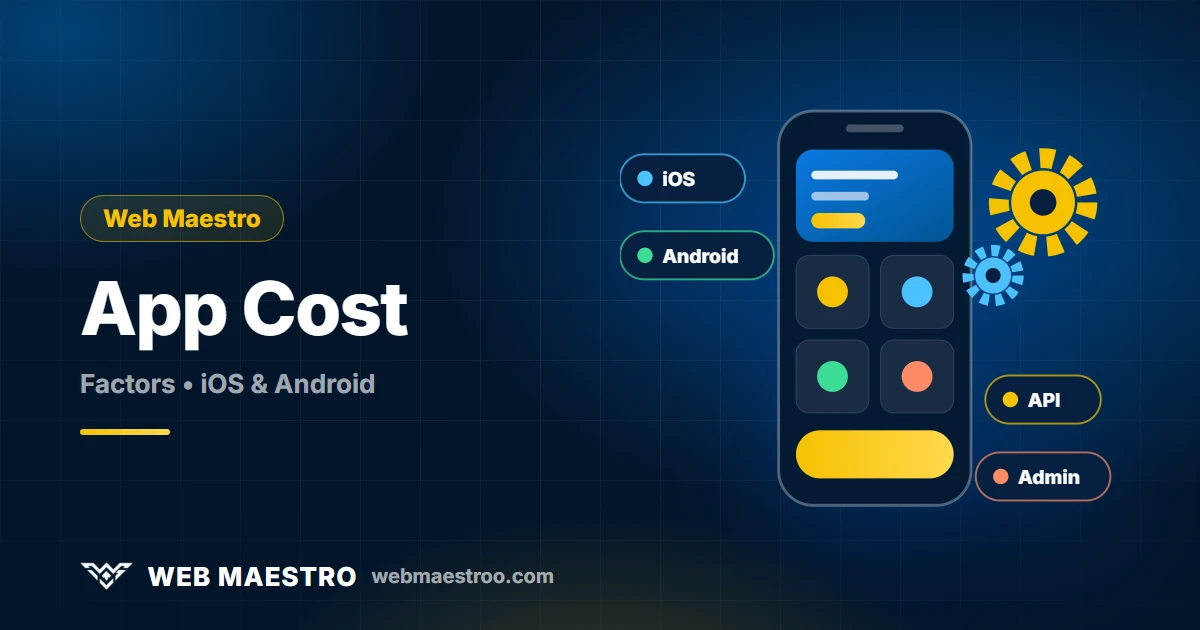
- An app is usually three products: the app itself, a back end (API and database) and an admin panel.
- Every extra user type (customer, driver, vendor, admin) adds screens, rules and testing.
- One cross-platform codebase for iOS and Android usually costs less than two native apps.
- Payments, maps, real-time tracking and chat are the features that add the most work.
- Budget for after launch: hosting, store accounts, updates for new phone systems and new features.
What you are really paying for
The part you see on the phone is only one piece. Behind it there is a back end that stores data and runs the business rules, an admin panel where your team manages users, orders and content, and connections to outside services. A quote that only mentions "the app" may leave the rest out.
The ten factors
1. Features and user roles
Sign-up, profiles, search, bookings, orders, ratings: each feature needs design, logic and testing. User roles multiply the work. A delivery service, for example, often needs a customer app, a driver app and a dashboard for stores.
2. Platforms
iOS only, Android only, or both? Cross-platform frameworks such as Flutter or React Native build both from one codebase, which suits most business apps. Fully native apps fit heavy graphics, complex device features or strict performance needs.
3. Back end and admin panel
Most apps need an API, a database, user management and an admin panel. If you already have a website or system, the app can sometimes reuse its back end, which saves time.
4. Design
Adapting a ready design system is quicker than a fully custom interface with animations. Arabic and English means mirrored right-to-left layouts and two sets of copy, which should be planned from the start.
5. Integrations
Payment gateways, maps, SMS codes, email, a CRM or ERP, shipping companies and analytics all need set-up and testing against their APIs.
6. Real-time features
Live order tracking, in-app chat and instant notifications need extra infrastructure and careful testing on poor connections.
7. Payments and store rules
Physical goods and services can be paid through your own payment gateway. Digital content sold inside the app must use Apple's and Google's in-app purchase, which takes a commission. This choice affects both the build and your margins.
8. Security, privacy and compliance
Login, encryption, permissions and audit logs protect your users. Health, finance and identity features may need extra checks, local hosting or verified sign-in.
9. Testing and store review
Apps must work on many phone models and screen sizes, and both stores review each release. Testing on real devices and preparing store listings in each language is part of the cost.
10. After launch
Hosting, monitoring, crash fixes, updates for new iOS and Android versions, and new features based on user feedback continue after the first release. Apple's developer program also has an annual fee and Google Play a one-time registration fee.
What drives the cost by type of app
| App type | What mainly decides the cost |
|---|---|
| Booking or services app | Calendar rules, payments, reminders, staff and admin views |
| Delivery app | Customer app, driver app, store dashboard, maps and live tracking |
| Store app | Catalogue sync with your website, checkout, push notifications |
| Internal company app | Roles and permissions, links to your ERP or CRM, offline use |
How to lower the cost without hurting the product
- Start with a focused first version. Launch the core journey, learn from real users, then add features.
- Use one codebase for iOS and Android unless you need native.
- Reuse what you have: an existing back end, design system or content.
- Use proven services for login, maps, notifications and payments instead of building them.
- Check whether you need an app at all. A fast website or progressive web app may be enough. See mobile app or website.
Does AI make apps cheaper?
AI speeds up parts of the work: interface drafts, repetitive code, tests and documentation. It does not replace product decisions, testing on real devices, store reviews or the integrations with outside providers. In practice it shortens timelines more than it changes what the app needs. A focused first version commonly takes about six to twelve weeks.
How to compare app quotes
- Give every provider the same feature list and user roles.
- Check that the back end, admin panel and store publishing are included.
- Ask which devices and OS versions will be tested.
- Agree who owns the code and the developer and store accounts. They should be in your company's name.
- Ask what support and updates are included after launch, and for how long.
Frequently asked questions
How much does it cost to build an app?
There is no fixed price. Features, user roles, platforms, integrations and the back end decide it. A written feature list, split into "first version" and "later", is the best way to get comparable quotes.
How much does a delivery app cost?
More than a single app, because it is usually three products: a customer app, a driver app and a store or admin dashboard, plus maps, live tracking and payments. Starting with one city and a limited feature set keeps the first version smaller.
Is it cheaper to build for iOS and Android at the same time?
Usually yes, with a cross-platform framework that shares one codebase. You still test and publish on both stores, but you avoid building every feature twice.
How long does it take to build an app?
A focused first version commonly takes about six to twelve weeks, depending on scope, integrations and store review. Larger platforms are built in stages.
What are the ongoing costs of an app?
Hosting and services, store developer accounts, monitoring, updates for new phone systems, fixes and new features. Ask for these to be listed separately from the build.
Next step
Describe your idea in a few minutes with our interactive project planner, see our mobile app development service, or contact us to scope a first version.
This article is no longer available. Back to blog