A professional website is not a brochure you publish once and forget. It is the place where customers decide whether to trust you, where search engines decide whether to show you, and where most of your marketing ends up. This guide walks through what a professional business website really needs in 2026, in the order you should think about it.
Key takeaways
- Start with the business goal (calls, leads, orders), not with colors and templates.
- Structure and content matter more to rankings than any plugin or trick.
- Speed, mobile usability and security are baseline requirements, not extras.
- Build for Arabic and English from day one if your customers use both.
- A site is a product: measure it, then improve it every month.
1. Define the goal before the design
Every page should exist for a reason. Before you open a design tool, write down the one action you want a visitor to take: request a quote, book a call, place an order, or message you on WhatsApp. Then decide how you will recognize success, for example the number of contact requests per month. A site with a clear goal is easier to design, easier to write and far easier to improve.
2. Plan the structure around what people search for
Good structure is the foundation of SEO. A typical company site needs a home page, one page per service, an about page, a contact page and a blog. The important part is the one page per service rule: a visitor searching for "e-commerce store development" should land on a page about exactly that, not on a long page that mentions it in passing.
- Use short, readable URLs such as
/services/ecommerce/. - Link related pages to each other so visitors and search engines can follow the topic.
- Keep the main menu to five or six items.
3. Write content that answers real questions
Search engines reward pages that fully answer a question. For each service page, cover what the service is, who it is for, how the process works, what the client gets, and the questions people ask before they buy. Write in plain language, use headings that describe the section, and avoid empty claims such as "best in the market" that nobody can verify. Specific, honest details build more trust than superlatives.
4. Make it fast on a real phone
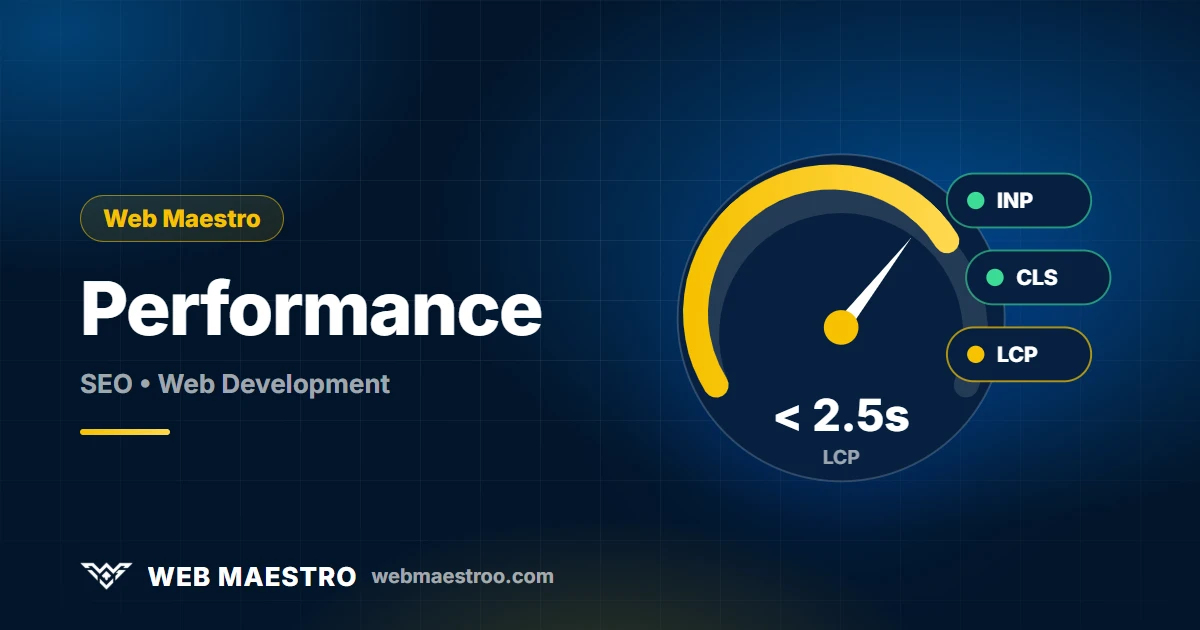
Most visitors will arrive on a mobile device over an average connection. Aim for the thresholds Google publishes for Core Web Vitals: a Largest Contentful Paint of 2.5 seconds or less, an Interaction to Next Paint of 200 milliseconds or less, and a Cumulative Layout Shift of 0.1 or less. The biggest wins are usually simple: compress and correctly size images, serve modern formats such as WebP or AVIF, load only the JavaScript a page needs, and use a fast host with a CDN. We cover this in depth in our guide to website speed and Core Web Vitals.
5. Design for trust and clarity
Good design is mostly clarity. Use a consistent set of colors and fonts, generous spacing, readable text sizes and one obvious primary button per screen. Show real proof: your own projects, named clients where you have permission, real contact details and a physical or registered business address if you have one. Avoid stock photos that make a company look generic.
6. Build the technical SEO basics in
Technical SEO is cheap to do at build time and expensive to retrofit. Make sure your site has:
- A unique title tag (about 50 to 60 characters) and meta description (about 120 to 160 characters) on every page.
- A single H1 per page and a logical H2 and H3 structure.
- A sitemap.xml and a robots.txt that does not block important pages.
- Canonical tags, and hreflang tags linking each Arabic page to its English equivalent.
- Structured data (Organization, LocalBusiness, Service, FAQ, BlogPosting) that matches what is visible on the page.
- Descriptive alt text on meaningful images.
If search visibility is a priority, a focused SEO service will align all of this with the keywords your customers use.
7. Treat security as a requirement
Use HTTPS everywhere, keep software updated, validate and sanitize every form, protect the admin area with strong authentication, and take regular backups. A hacked or flagged site loses both visitors and rankings, and recovering from it costs far more than preventing it.
8. Support Arabic and English properly
If your customers speak both languages, build both versions as first-class sites: right-to-left layout for Arabic, a proper Arabic typeface, translated URLs and metadata, and a language switch that takes the visitor to the equivalent page rather than the home page. This is also what lets Google show the correct language to each searcher.
9. Launch checklist
- Every form delivers messages to a monitored inbox, and you have tested it.
- Phone numbers and WhatsApp links work on mobile.
- Title, description and canonical are set on every page.
- The site is submitted to Google Search Console and Bing Webmaster Tools.
- Analytics is installed and respects visitor consent where required.
- You have tested on at least one iPhone, one Android phone and one desktop browser.
- A backup and a way to restore it exist.
10. Accessibility is good design and good business
Accessible sites work for more people: those using screen readers, people with low vision or motor difficulties, and anyone on a bright screen outdoors. The basics are inexpensive when planned early. Keep text contrast high, make sure every button and link can be reached and used with a keyboard, write meaningful alt text, label every form field, and never rely on color alone to convey meaning. Search engines also benefit, because clean semantic HTML is easier to understand. Run a quick check with the Lighthouse accessibility audit and fix what it flags before launch.
11. Choose the right technology for the job
There is no single best platform. A content-focused company site is usually best served by a fast, mostly static build with a small amount of JavaScript, because it loads quickly and is simple to secure. An online store needs a catalog, payments, inventory and order management, so it calls for a platform or custom system designed for commerce. A web application with logins, dashboards and data needs a proper backend and database. Ask three questions: who will update the content and how often, which systems must it connect to, and how much traffic and growth do you expect? The answers matter more than the brand name of any tool.
12. How to choose a web partner
A good agency should be able to explain its decisions in plain language. Look for these signs:
- They ask about your business goals and customers before talking about design.
- They can show real, live projects that you can open and test on your own phone.
- They explain how they handle SEO, speed, security and Arabic and English support as part of the build, not as paid extras.
- They give you ownership of your domain, hosting account and code, and document how everything works.
- They are clear about what happens after launch: support, updates and who to call when something breaks.
Be careful with promises of guaranteed rankings or instant results. Nobody controls search engines, and honest partners say so.
13. After launch: maintenance and growth
The launch is the starting line. Plan a monthly routine: review analytics and Search Console, check that forms and phone links still work, update software and dependencies, test speed again and publish or refresh content. Keep a short list of improvements ranked by expected impact, such as clearer calls to action, a new service page, or faster images. Small, steady changes compound far better than a complete redesign every few years.
14. Common mistakes to avoid
- Choosing a design first and fitting the content in afterwards.
- Putting everything on the home page instead of building service pages.
- Uploading full-size photos straight from a phone or camera.
- Forgetting the mobile experience until the end.
- Launching and never looking at the analytics again.
Frequently asked questions
How long does it take to build a professional website?
It depends on the scope: the number of pages, the amount of content, integrations and languages. A focused company site is a much smaller project than a store or a custom system, and the content is usually what takes the longest. A good partner will give you a realistic plan after understanding your goals.
Do I need a custom website or is a template enough?
A template can be enough to start. A custom build makes sense when you need strong performance, unusual features, integrations with your own systems, or a brand experience that a template cannot deliver.
How soon will I see results from SEO?
Search engines need time to discover, crawl and trust a new site, so improvement is gradual. A well-structured site with useful content and a good technical base gives you the best starting point, and results build as you publish and improve.
Should my site be in Arabic, English or both?
Use the languages your customers actually search in. For many businesses in Jordan and the region that means both, with each language built properly rather than machine-translated.
What should a business website include on the home page?
A clear statement of what you do and for whom, your main services, proof such as projects or testimonials you can verify, and one obvious way to contact you. Details belong on the service pages, which the home page should link to.
Who owns the website after it is built?
You should. Make sure your agreement states that you own the domain, the content and the code, and that you hold the logins to hosting and analytics accounts.
Next step
If you are planning a new site or rebuilding an old one, our team can review your goals and propose a clear structure. See our web development service or contact us for a free consultation.
This article is no longer available. Back to blog